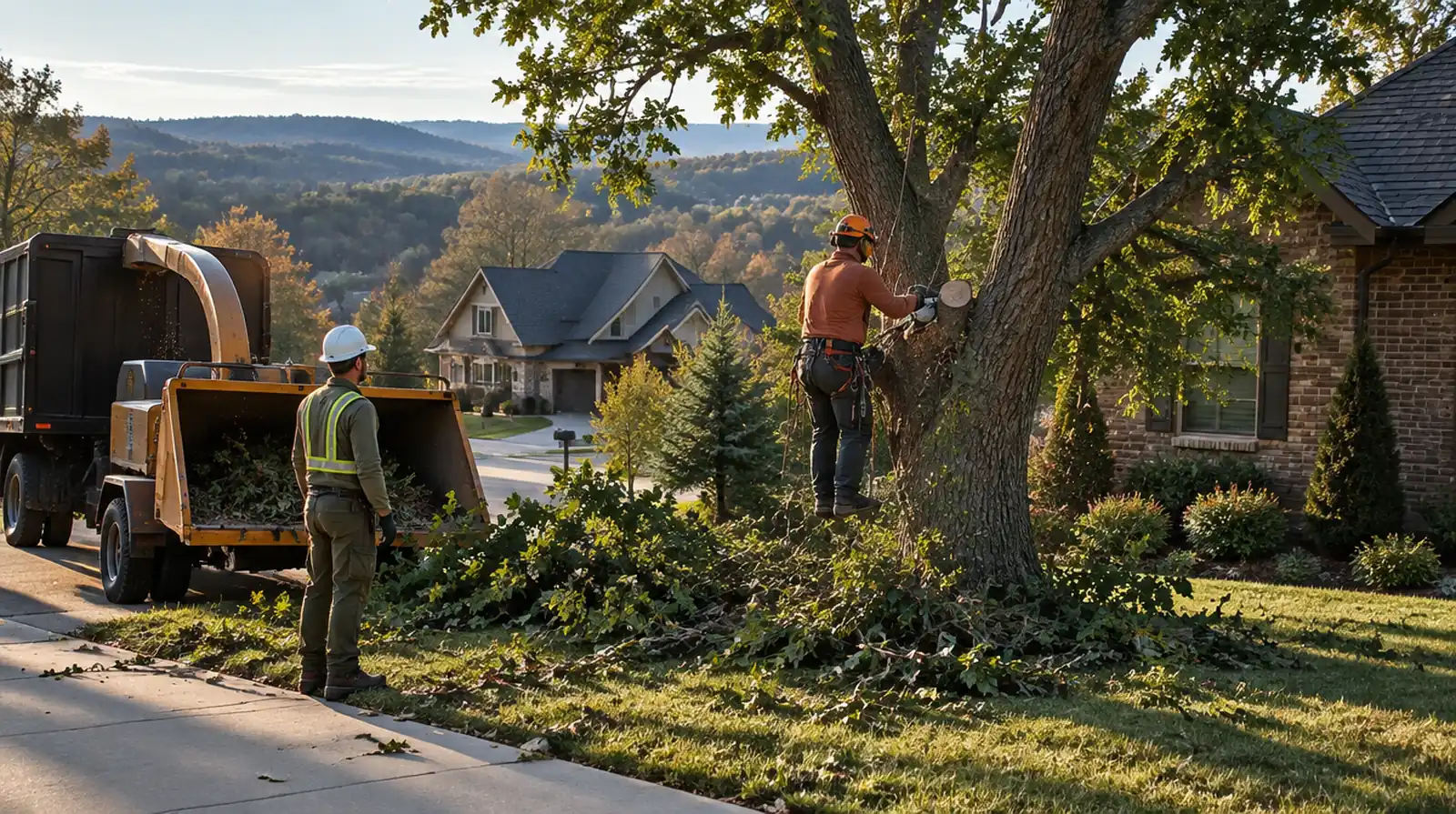
Trees in this part of the Ozarks fail in ways that surprise people
Bentonville sits on the edge of the Springfield Plateau, which means a lot of yards here have eight or ten inches of soil sitting on top of fractured limestone and chert. A white oak that looks enormous and permanent may have a root plate barely wider than its drip line, spread sideways across rock because it had nowhere to go down. That tree stands fine for sixty years. Then we get four inches of rain in a night, the ground goes soft, a straight-line wind comes through ahead of a spring storm, and the whole root plate lifts like a trap door.
That's the single most common call we get, and it's why we look at the ground around a tree before we look at the tree. Soil, lean, and root condition tell us more than crown health does.
The other pattern is ice. Anyone who was here in January 2009 remembers what a half inch of radial ice does to a mature canopy. Ice loads the small stuff first, so trees with lots of fine branch tips and weak unions come apart before anything else. Bradford and callery pears split straight down the middle at the trunk union almost every time. Silver maples shed whole leaders. Sweetgums drop limbs across driveways. Post oak and shagbark hickory hold up better, but they're brittle when they do fail, and hickory in particular tends to break rather than bend.
Then there's the slow stuff. Green and white ash across Benton County are dying from emerald ash borer, and a dead ash gets dangerous fast because the wood turns brittle within a season. Red oaks stressed by our late-summer droughts pick up hypoxylon canker and start shedding bark in sheets. New subdivisions around Centerton and southeast Bentonville lose trees three or four years after construction, when the roots that got cut for a utility trench or buried under eighteen inches of fill finally give out.
What we do
Five things, and we do them properly rather than doing everything badly. If you need a hazardous tree dropped in a tight yard, that's rigging work and we'll bring the right crew for it. If the tree is healthy and you'd rather thin a heavy canopy before storm season, that's a different job and a different price. Tell us which one you're looking at, or let us come look and tell you.
- Tree Removal
Whole-tree takedowns, including trees over houses, fences, and power drops.
- Tree Trimming & Pruning
Deadwooding, crown reduction, clearance pruning, and structural work on young trees.
- Stump Grinding
Stumps and surface roots ground below grade so you can seed, sod, or build over them.
- Emergency Storm Damage Tree Removal
Fast response for trees on structures, blocked drives, and hangers after a storm.
- Land & Lot Clearing
Building pads, pasture reclamation, fence lines, and overgrown acreage.
Once a tree is down, most people want us to grind the stump out below grade the same week so they can put topsoil and seed over it before the yard gets away from them. And if a tree is already on your roof or across your driveway right now, we can usually get a crew out the same day.
How we price the work
Nobody can quote a real number over the phone, and anybody who does is guessing high to protect themselves. What actually drives price is access: how close we can get equipment to the tree, what's underneath it, and where the wood has to travel to reach the chipper.
A sixty-foot red oak in an open field is a straightforward job. That same tree twelve feet off a house, over a fenced yard with a pool, with power service running through the canopy, is a rigging job where every piece has to be roped down individually. Same species, same height, several times the labor. That's the whole explanation for why quotes vary so much between properties on the same street.
We give you a written number before we start, and that number doesn't move unless you add work. No deposit for standard jobs. We take card, check, or cash when the work is done and you've walked the yard with us.
Where we work
We're based in Bentonville and cover Bentonville, Bella Vista, Centerton, Rogers, Cave Springs, Pea Ridge, Little Flock, Highfill, Gravette, and Lowell. That includes the older streets around the downtown square where the big canopy trees are, the newer builds out toward Highfill, and the steep wooded lots up in Bella Vista where half the work is figuring out how to get equipment down the hill in the first place.
Bella Vista deserves a note of its own. Those lots are heavily treed, often on slopes, and frequently have a house tucked below the trees rather than beside them. Gravity does a lot of the work for us and all of the work against us. We rope more and drop less on those properties, which takes longer, and we'll tell you that up front instead of surprising you with it.
Working with us
You call or send the form. We come look, usually within a day or two, and you don't need to be home for the estimate unless the tree is behind a locked gate. You get a written price. If you say go, we schedule you, and we call the day before to confirm.
On the day, we tarp what needs protecting, take the tree down, chip the brush, and rake the yard. Wood goes with us unless you want it left, and plenty of people around here do want it left. Say so and we'll cut it to stove length and stack it. The crew behind the name has been doing this in Northwest Arkansas long enough to know which yards you can drive a truck across in March and which ones you absolutely cannot.
Questions people ask before they book
What does tree removal cost in Bentonville?
Most single-tree removals in town land somewhere between a few hundred dollars for a small yard tree and several thousand for a mature oak over a structure. The spread is real and it comes down to access, size, and what's under the tree. We'll give you a firm written number after we look at it, at no charge.
Do you haul off the brush and the wood?
Yes. Brush gets chipped and hauled, and the trunk wood goes with us unless you ask us to leave it. We rake the drop zone and blow off the drive and walkways before we go. If we drove equipment across the lawn, we'll tell you what to expect in terms of ruts and what we've done about it.
How soon can you get here?
Estimates usually within a day or two. Scheduled work typically runs one to two weeks out, less in winter when the calendar is lighter. Trees on houses, blocked driveways, and limbs hanging over where kids play get moved to the front of the line, same day when we can.
Are you insured, and can I see proof?
Yes, and yes — ask and we'll send a certificate of insurance directly from the carrier before we start. This matters more than people realize. If an uninsured crew drops a limb through your roof, that becomes your problem and your claim. Ask every company you call, not just us.
Does my homeowners insurance cover this?
Usually only after something has already happened. Most policies in Arkansas cover removal when a tree has fallen on a covered structure, and most do not cover taking down a tree that's merely dangerous. We're not the ones to give you coverage advice, but we can document the tree and the damage for your adjuster, and we do it often.
What time of year should I have a tree pruned?
Late winter is best for most species here — the structure is visible, the tree isn't spending stored energy, and beetle pressure is at its lowest. That last point matters for oaks specifically: pruning red oaks in spring and early summer raises the risk of oak wilt spreading through fresh cuts. Dead and hazardous limbs come off whenever we find them, season regardless.
What do you need from me on the day?
Cars out of the driveway, gates unlocked, dogs inside, and anything breakable moved off the deck. That's it. You don't need to be home, though most people like to be.
Get a number on your tree
Call (479) 342-4480 and talk to someone who does this work, or send the details and we'll come look. Estimates are free and we don't chase you afterward.